Why certificate verification is free forever on Certifada (and why your credentials outlive your subscription)
Two guarantees most credentialing platforms do not make: verification is never metered or rate-limited, and every credential stays verifiable even after the issuer stops paying. Here is why, how it works, and what to ask any vendor.
 Certifada TeamEditorial team5 min read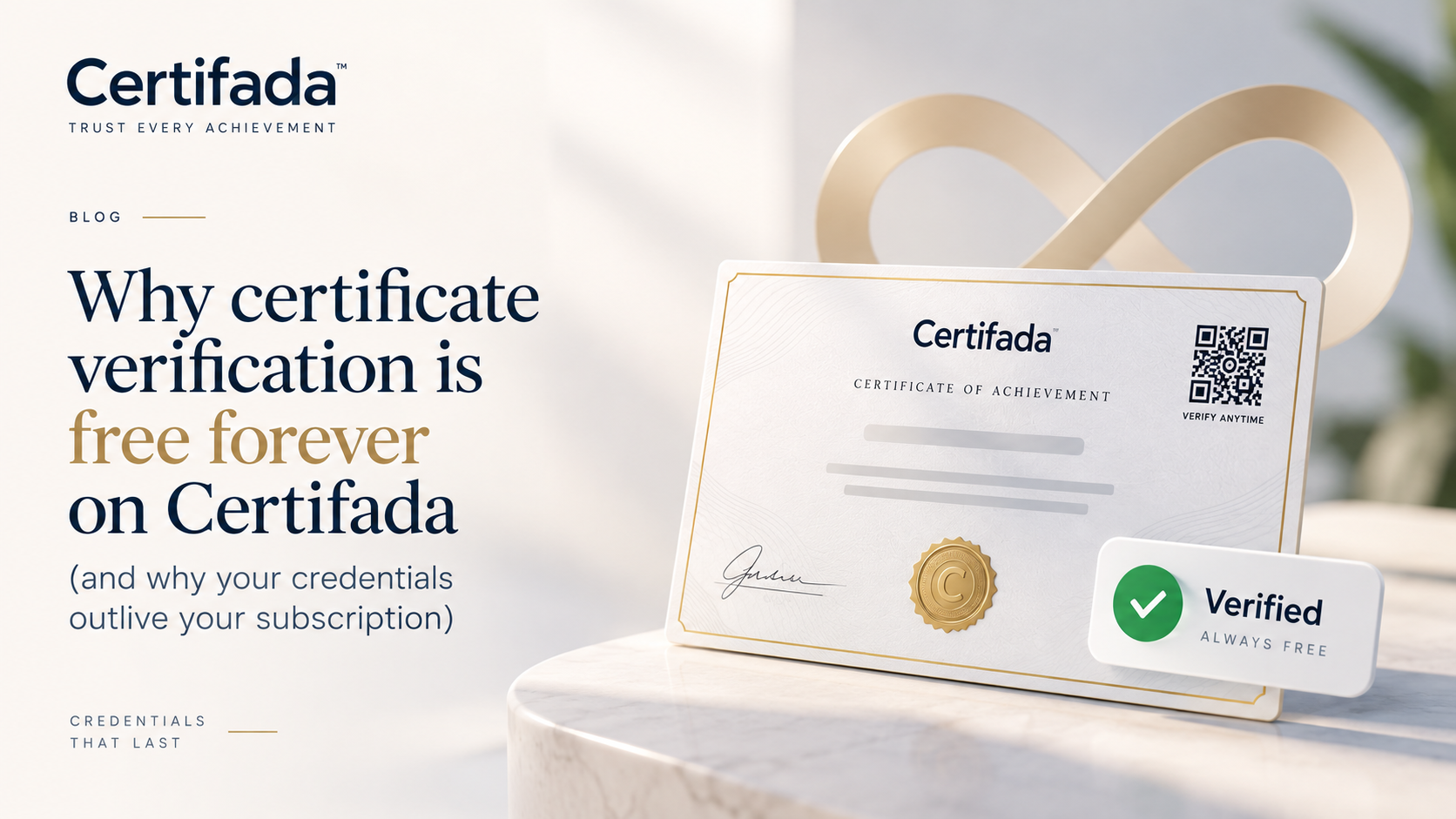
There is a quiet clause in many credentialing contracts: verification is part of the subscription. Stop paying, or exceed a quota, and the certificates you already issued stop being checkable. The recipient did nothing wrong. The employer checking it did nothing wrong. The link simply dies, and with it the value of every certificate you ever sent.
Certifada makes the opposite commitment, and this article explains what it means in practice, why we designed the platform this way, and what to ask any vendor before you trust them with credentials that are supposed to last a career.
The two guarantees
Verification is never metered. Every credential issued on Certifada has a public verification page reachable by link and QR code. Anyone can open it, as many times as they like, on any plan including the free one. There is no verification quota, no rate limit for the person checking, and no login or fee to see the result.
Credentials stay verifiable after a subscription ends. If an issuer downgrades, pauses or cancels, the certificates they issued remain on their verification pages, still showing the recipient, the issuer, the date and the current status. Recipients keep what they earned.
These are not features you switch on. They are how the platform works.
Why a certificate's value lives at the verification step
A certificate is only ever as strong as the moment someone doubts it. That moment usually arrives years after issuance: a hiring manager checking a claim, an admissions officer confirming a prerequisite, a regulator auditing a training record. If the verification page has to exist then, the issuer's billing status today should be irrelevant to it.
Metered verification also creates a perverse incentive for the issuer. The more useful your credentials become — the more often people check them — the more it costs you. A programme whose certificates are actually being verified should be a success story, not an overage invoice.
What "verifiable" has to include
For the guarantee to be worth anything, the verification page must show enough to settle the question:
- Who was it issued to, with the name exactly as printed.
- Who issued it, on a page the issuer controls and branded as theirs.
- When, including any expiry the issuer set.
- Current status — valid, expired or revoked — because a certificate that was withdrawn must say so rather than quietly vanish.
Certifada's verification pages show all four. A revoked credential is not deleted; it is marked, so the history of the claim stays honest.
How this holds up technically
A few design decisions make the promise sustainable rather than merely generous:
- Verification is separated from the issuing account. The public page is served from the credential record, not from the issuer's session or plan state, so a change to the account does not touch the page.
- Verification is cheap to serve. Verification pages are read-only and cached at the edge. Answering "is this real?" a million times costs a fraction of issuing once, which is why there is no reason to charge for it.
- Credentials carry their own proof. The QR code on the printed or downloaded certificate resolves to the same page, so a recipient who lost the email still has a working link in their hand. Credentials added to Apple Wallet or Google Wallet keep that QR code one tap away.
- Open standards where they matter. Badges are issued as IMS Open Badges 2.0 with hosted verification and can be baked into the PNG, so they can be imported into other badge platforms and verified without depending on Certifada's interface.
What this means for recipients
Recipients rarely choose the platform their certificate lives on, so the platform should be fair to them by default. On Certifada a recipient can share a link or a QR code with anyone, forever, and the person on the other end will see a clear answer without creating an account. There is nothing to renew and nothing that expires with someone else's subscription.
What this means for issuers
For issuers the guarantee changes how you can talk about your programme. You can print the QR code on a physical certificate and know it will resolve in ten years. You can tell alumni that their credentials do not depend on your procurement cycle. And you can start on the free plan, issue a real cohort, and be certain that upgrading or not upgrading later never affects what you already issued.
It also makes the platform easier to trust in a tender: a credentialing tool that cannot hold your certificates hostage has one fewer lock-in to explain.
Questions to ask any credentialing vendor
Whether or not you choose Certifada, these five questions separate a durable credentialing platform from a subscription with certificates attached:
- Is there any limit on how many times a credential can be verified, or a charge above a threshold?
- Does the person verifying need an account, an app or a payment?
- What happens to existing verification pages if we cancel?
- Does a revoked credential show as revoked, or does the page disappear?
- Can badges be exported in an open format and verified elsewhere?
Certifada's answers are: no limit, no account, they stay up, it shows as revoked, and yes. You can verify a credential yourself right now to see what a recipient's link looks like, or read the comparison pages for how this differs from other tools.
Related articles
 Guides
How to issue verifiable digital certificates: a practical guide
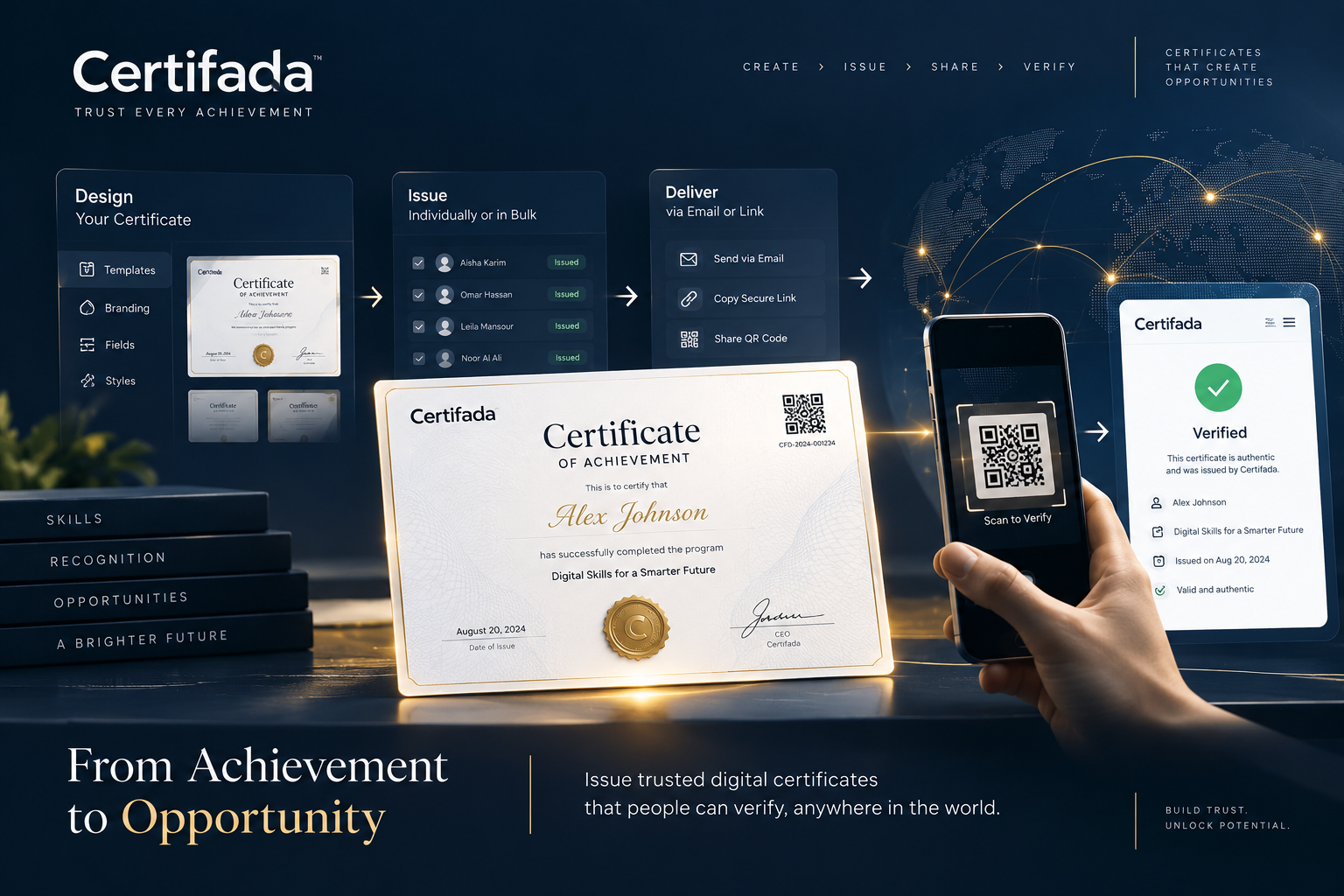
What makes a certificate verifiable, and how to get there: a reusable template, bulk issuance from a spreadsheet, wallet delivery, and a public verification page anyone can check in seconds.
Certifada Team 5 min read