Stop issuing certificates that say nothing
A name, a date, a seal and the word "completion" answer none of the questions a recruiter or admissions officer actually has. Here are the five questions a certificate must answer, the wording that moves from "attended" to "demonstrated", how to align to a framework such as CEFR, and how criteria, skills and validity become data an employer's software can read.
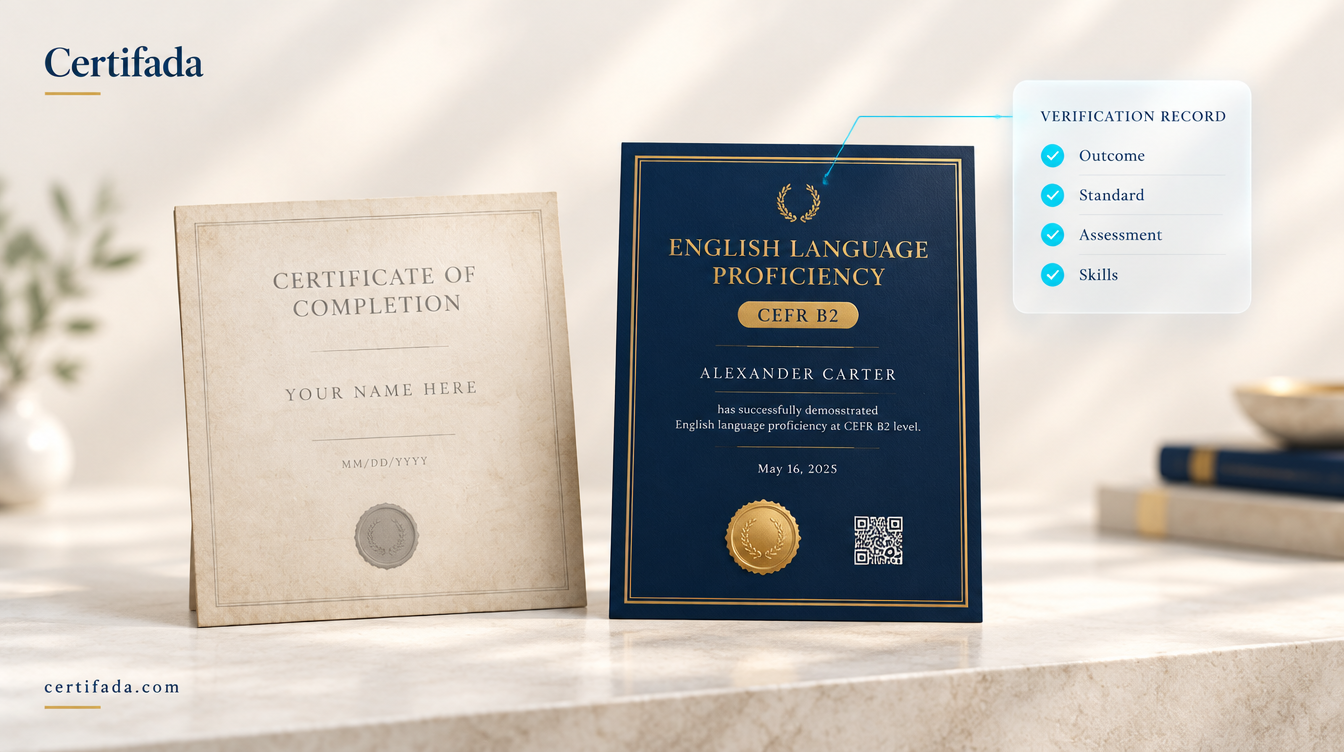
Certificate of Completion. A name. A date. A signature. A seal.
That is what most certificates say, and it is almost nothing. It tells a reader that a person was present for something that ended, and it leaves every question they actually have unanswered. Which course? At what level? What can this person now do that they could not do before? Measured how, and against what? Even a certificate with a perfect verification record behind it is only half useful if the record confirms a claim that does not say anything.
There are two ways a certificate can fail a verifier. It can be fake, which we have written about here and here. Or it can be empty. This article is about the second failure, which is far more common and entirely within the issuer's control.
The five questions a certificate has to answer
Put yourself in the seat of the person who has to act on the certificate: a recruiter, an admissions officer, a client, a licensing body. They are not admiring the design. They are trying to answer five questions, and a certificate is good exactly to the extent that it answers them without a phone call.
- What was this? The programme, named the way the world knows it, not an internal code.
- What can the holder now do? An outcome, stated as a capability, not as attendance.
- Against which standard? A level on a framework other people recognise: CEFR for languages, a vendor track for technical skills, a national qualification level, an industry body's syllabus.
- How was it assessed? Exam, project, practical assessment, portfolio review, supervised hours. "Completed" is not an assessment.
- Who says so, and how do I check? The issuer, verified, and a record I can reach.
Most certificates answer the first and the fifth. The middle three are where the value lives, and they are usually blank.
From "attended" to "demonstrated"
The single biggest improvement an issuer can make costs nothing: change the sentence.
Compare these two, for the same student and the same course:
Certificate of Completion. This is to certify that Sara Ahmed has completed the General English course.
English Language Proficiency, CEFR B2 (Upper Intermediate). Sara Ahmed demonstrated B2-level reading, listening, speaking and writing in a supervised examination on 12 June 2026, following a 120-hour programme. Valid for two years from the date of assessment.
The second one took thirty seconds longer to write and answers every question on the list. A recruiter in another country can read it, map it to their own scale and move on. An employer's system can parse it. The graduate can defend it in an interview.
A useful pattern for the wording:
- Title: the skill and the level, not the word "completion".
- Outcome sentence: "demonstrated", "achieved", "was assessed at", followed by what and at what level.
- Assessment: how, when, and by what method.
- Scope: hours, modules or scope of practice, if it helps the reader.
- Validity: when this claim should be re-checked, if the skill decays.
In a bilingual market, write both languages with the same precision. An Arabic wording that says "شارك في دورة" next to an English one that says "demonstrated B2 proficiency" is two different certificates on one page.
Map it to a framework people already trust
A level means nothing on its own. "Level 3" at one institute is "Intermediate" at another and "Band 5" at a third. A level on a framework the reader already trusts means everything.
For languages the answer is CEFR: six levels, understood by employers, universities and immigration authorities across the world. A certificate that says B2 needs no explanation. One that says "Upper Intermediate, Level 4" needs a phone call.
For other fields the same logic applies: a vendor's own certification track, a national qualifications framework, an occupational standard, a professional body's syllabus. Whatever the reader already uses to make decisions, align to it and say so on the certificate.
In Open Badges this has a name: alignment. A badge carries the name of the standard, a link to it, the framework it belongs to and the code of the level. That is not decoration. It is the field an employer's software reads to decide whether the credential meets a requirement.
Turn prose into data
A sentence on a certificate is for people. The same facts as structured data are for the systems people increasingly use to screen candidates, including the AI tools that now read CVs and try to verify what they find.
An Open Badge gives every claim a field:
- Criteria: what the holder had to do to earn it, as a short narrative and, if you have one, a link to the syllabus or assessment policy.
- Skills: the capabilities the credential attests, as tags an employer's system can match against a job description.
- Alignment: the framework and level, as above.
- Evidence: the record itself, reachable by anyone, showing the issuer, the recipient, the dates and the current status.
- Expiry: when the claim lapses, so a five-year-old language result is presented as what it is.
Write these once, per template, and every credential issued from it carries them. A certificate becomes something a machine can read, compare and trust, without losing anything a human sees on the page.
Say when it stops being true
Some skills decay. A language level drifts if unused. Safety and compliance training is renewed for a reason. A certificate that presents a 2019 assessment as current in 2026 is not lying, but it is not helping either.
Give time-limited claims a validity period. The verification page then says valid, expiring or expired, with dates, and the wallet pass on the graduate's phone shows the same. Nobody is misled, and the institute earns the renewal instead of losing the alumnus to silence.
A worked example
A language institute issues a B2 certificate. Here is the difference between saying nothing and saying everything, on the same template:
| Says nothing | Says everything | |
|---|---|---|
| Title | Certificate of Completion | English Language Proficiency, CEFR B2 |
| Outcome | Has completed the General English course | Demonstrated B2-level reading, listening, speaking and writing |
| Assessment | (none) | Supervised written and spoken examination, 12 June 2026 |
| Standard | (none) | CEFR, Council of Europe, level B2 |
| Skills | (none) | English reading B2, listening B2, speaking B2, writing B2 |
| Validity | (none) | Two years from assessment |
| Languages | English only | English and Arabic, same wording |
Same student, same course, same afternoon. One is a souvenir. The other is a credential.
How to do it in Certifada
Everything above is a field, not a project:
- Name the template the way the programme is sold, with the level in the name.
- Write the outcome sentence into the certificate body, in both languages if your recipients present it to both.
- Open the badge settings on the template and fill in the criteria narrative, the skills tags and the alignment to your framework, with its link and level code.
- Set a validity period on templates whose claims decay.
- Complete issuer verification so the "who says so" question is answered by someone other than you.
- Print the verification QR so the "how do I check" question is answered in one scan.
From then on every credential from that template says everything, is readable by software, and points to a record that stays up. That is what a certificate is for. Everything else, as we argued in the certificate outlives the institute, is paper.

Related articles
 Digital credentials
The certificate outlives the institute. Design for that
A certificate is issued in an afternoon and needed for forty years, while the institute behind it renames, rebrands, changes software or closes. Here are the three ways certificates die, the six properties that make permanence a design requirement rather than a promise, and what an issuer should do on the day of issue.
Certifada Team 6 min read Guides
How to issue verifiable digital certificates: a practical guide
What makes a certificate verifiable, and how to get there: a reusable template, bulk issuance from a spreadsheet, wallet delivery, and a public verification page anyone can check in seconds.
Certifada Team 5 min read Digital credentials
AI can forge a certificate in ten seconds. The only defence is a record that is not the certificate
Image models now produce a flawless fake certificate for free: logo, seal, signature, foil, even the QR code. Every visual cue verifiers rely on is worthless. What is left is a record held somewhere the forger cannot write to. Here is what that means for anyone who checks certificates, and for anyone who issues them.
Certifada Team 7 min read Digital credentials
Why certificate verification is free forever on Certifada (and why your credentials outlive your subscription)
Two guarantees most credentialing platforms do not make: verification is never metered or rate-limited, and every credential stays verifiable even after the issuer stops paying. Here is why, how it works, and what to ask any vendor.
Certifada Team 5 min read